
Organizing a themed party often feels like trying to walk a tightrope: you want to impress your guests with your creativity, but you don’t want to end the night falling asleep in your plate from exhaustion. Most people mistakenly believe that a “theme” requires a total transformation of their living space. In reality, success lies in the effect of presence, not in the budget or the number of hours spent cutting out paper stars.
Here is your comprehensive strategic guide on how to create an atmospheric event while keeping your sanity intact.
1. The “Three Anchor” Strategy: Focus Your Impact
Instead of scattering your attention across a hundred tiny things, focus on what guests will actually notice. Psychology tells us that people remember the general mood and 2–3 vivid details.
How to choose your anchors?
Pick three items from this list to serve as the foundation of your theme:
- The Soundscape (Playlist): This is the cheapest and most effective way to set a theme. If it’s “Cyberpunk,” put on synthwave. If it’s “Italian Summer,” play 1960s Italian pop. Music fills the gaps in conversation and subconsciously maintains the vibe.
- Lighting Scenarios: Turn off the harsh overhead lights. Use floor lamps, string lights, or smart bulbs set to a specific color. Lighting instantly changes the geometry and mood of a room.
- One Large Focal Point: Instead of hanging balloons everywhere, create one “power zone.” This could be a drink station decorated to match the theme or a large projection/poster on the wall.
- Simplified Dress Code: Don’t force people to hunt for Victorian-era costumes. Suggest an “element”: “wear something red” or “come in a hat.” This engages guests without stressing them out.
2. A Simplified Planning Flow
Distributing tasks over time is the only way to avoid “pre-deadline paralysis.” The main secret: the 80/20 principle. 80% of your results come from 20% of the effort put in early.
Phase 1: The Concept (2 Weeks Out)
- Define the theme and set a budget limit.
- Create a group chat or send out digital invitations.
- Crucial Step: Check if you have enough basic glassware and seating.
Phase 2: Logistics (1 Week Out)
- Finalize the menu. Choose dishes that can be made in advance or ordered.
- Order any specific decor online.
- Finalize the playlist (or find a curated one on Spotify).
Phase 3: Base Prep (2–3 Days Out)
- Buy alcohol and non-perishable groceries.
- The Bathroom Audit: Ensure there are enough clean towels and soap—this is the one room every single guest will visit.
Phase 4: The Final Sprint (Day X)
- Morning: Prepare cold appetizers and chill the drinks.
- 2 Hours Before: Do a quick cleaning of “public zones” only (living room, kitchen, bathroom).
- 1 Hour Before: STOP. This is time for your own rest, a shower, and getting dressed.
3. Details that Work: Invites, Signs, and Labels
Small details are the “secret ingredient” that makes a party feel polished. They don’t require much money, just a little intentionality.
The Digital Business Card (Invitations)
Use free tools like Canva or Pinterest. Your invite should include:
- Timing: Start time and (importantly!) an approximate end time.
- Location: A Google Maps link.
- The Wish-List: What to bring (or a note saying “we’ve got it covered”).
Navigation for Comfort
Guests feel awkward when they don’t know where to get water or where to put a dirty glass.
- Prompt Signs: “Clean glasses here,” “DIY Bar — Mix like a pro,” “Wi-Fi password.”
- Food Labels: If you have vegetarian dishes or common allergens (nuts, gluten), label them. It shows you care without you having to explain it 20 times.
- Thematic Names: A simple cheese plate becomes “Captain’s Treasure” at a pirate party. It takes 30 seconds to write the card but creates 100% more engagement.
4. Radical Ways to Reduce Setup Stress
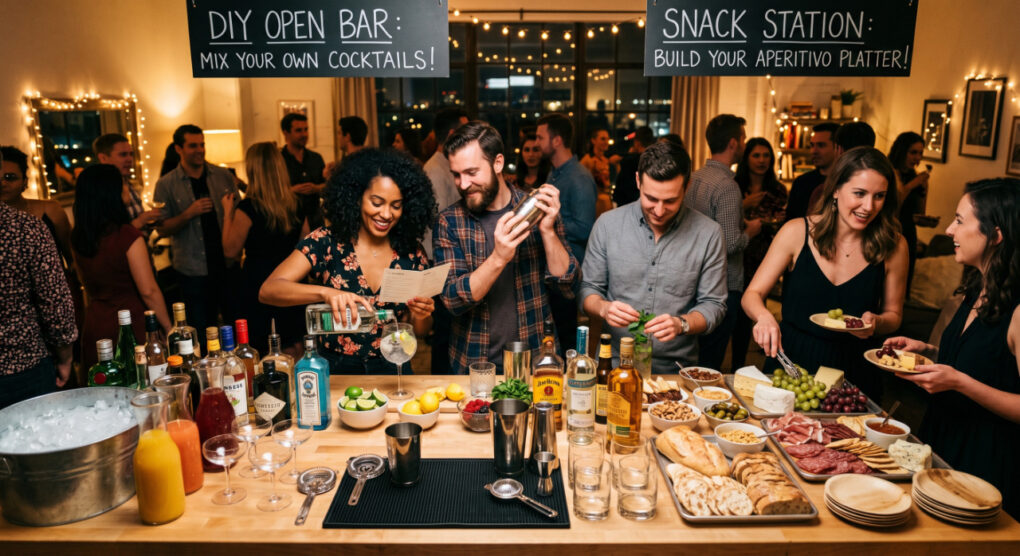
Stress occurs where there is perfectionism and an attempt to control everything alone.
The “Open Bar” Strategy
Don’t try to be the bartender. Set up a self-service station:
- Lay out the spirits, mixers (tonic, juice), ice, and sliced garnishes.
- Print one simple instruction: “Cocktail of the Night: 1 part X + 2 parts Y.” Guests love feeling like mixologists, and you are free to socialize.
Outsourcing and Delegating
You are not taking a culinary school exam.
- Ordering food from a restaurant is perfectly fine. Plate it on your own nice dishes, and it will feel “at home.”
- If friends ask “What can I bring?”, don’t say “Nothing.” Say: “Bring your favorite drink” or “A bag of ice.” Ice always runs out at the worst moment.
The “Empty Dishwasher” Hack
Start the party with an empty dishwasher and an empty trash can. This allows you to quickly clear away the “mid-party mess” without creating mountains of clutter on your counters.
Lighting as an Anti-Stress Factor
If you didn’t have time to perfectly dust the high shelves—just dim the lights. Twilight accented by the warm glow of candles or fairy lights hides any cleaning flaws and makes everyone look more attractive.
Summary: The Golden Rule of Hosting
The most important element of the party is your mood. If you are running around with a rag or nervously checking the oven, your guests will feel guilty for your discomfort.
Pick a simple theme, make a great playlist, label the snacks with funny names—and that’s it. As soon as the first doorbell rings, your job as an organizer is over. Now, you are just another guest at a wonderful party that (as it happens) you threw yourself.